0

December 18, 2025
Who Gets to Be “Professional”? Accounting vs. the DOE
By: Center For Accounting Transformation / podcast
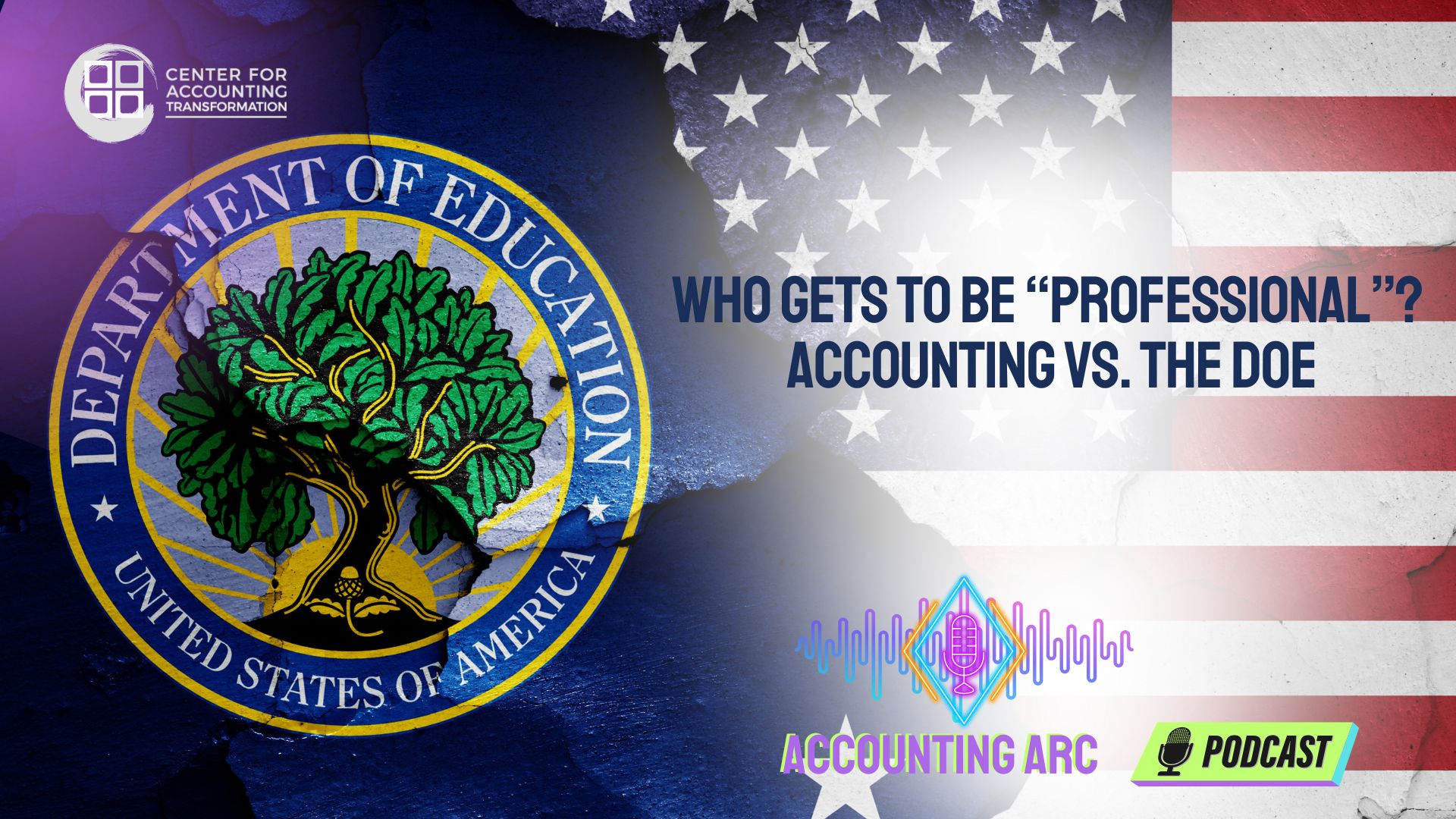
A new definition of “professional degree” limits loan access for accounting students and raises fresh alarms about equity, access and pipeline.
New federal loan caps and a narrow definition of “professional degree” raise urgent questions about access, equity and the future of the accounting pipeline.
In this episode, hosts Liz Mason, CPA; Byron Patrick, CPA.CITP; and Donny Shimamoto, CPA.CITP, CGMA, tackle one of the most controversial developments yet: the U.S. Department of Education’s decision to treat most accounting master’s programs as non-professional for student loan purposes.
New loan caps redefine what counts as a professional degree.
Under the “One Big Beautiful Bill” Act, beginning in July 2026 new graduate borrowers face strict federal caps: $20,500 per year and $100,000 lifetime. Students in a small set of “professional degree” programs—such as medicine, dentistry and law—can borrow up to $50,000 per year with a $200,000 lifetime limit.
Accounting, nursing, education, engineering and several other fields are placed in the lower “graduate” tier, not the higher “professional” tier.
Mason, CEO of High Rock Accounting, argues that this decision sends a clear message: “If you are not pursuing a profession, then the merits of higher education are not as valuable.” She worries that the signal is both financial and symbolic—especially for students who already struggle to see accounting as a prestigious, future-proof career.
Long-standing definitions collide with a changing profession.
Shimamoto, founder and managing director of IntrapriseTechKnowlogies and founder and inspiration architect for the Center for Accounting Transformation, comes at the issue from the regulatory side. He points to Department of Labor rules under the Fair Labor Standards Act, which list accounting alongside law, medicine, theology, engineering and architecture as a “field of science or learning” for the learned professional exemption.
“If the labor side of the federal government explicitly calls accounting a learned profession, how does the education side say it isn’t?” he asks. The clash exposes how outdated definitions from the 1960s are still driving modern policy.
For Mason, the biggest concern is equity. She believes the loan caps will hit first-generation, low-income and nontraditional students hardest, particularly those who rely on graduate programs to pivot into accounting or reach senior roles such as CFO.
Patrick, co-founder and educator with TB Academy and senior product manager with Karbon, sees a possible upside if the changes pressure universities to lower tuition, but he admits that “the cost of education has become irrationally obscene” and that the short-term impact on students could be severe.
Shimamoto is less convinced that reduced access to master’s-level funding will dramatically shrink the pipeline, especially as more states roll back the 150-hour requirement and explore alternative pathways to licensure. But all three agree on one point: accounting is a profession, and its status in federal policy matters.
Accountants are urged to speak up and shape the rules.
The hosts close with a clear call to action. As national groups like the AICPA and NASBA push back on the proposed definition of “professional degree,” practitioners will see more alerts and advocacy campaigns.
“When you get that email asking you to contact your legislators, don’t ignore it,” Shimamoto says. “This is one of those moments where your voice really does shape the future of the profession.”
Don’t miss an episode. Be sure to SUBSCRIBE below: