0

August 10, 2026
The CPA Career Nobody Talks About
By: Center For Accounting Transformation / podcast
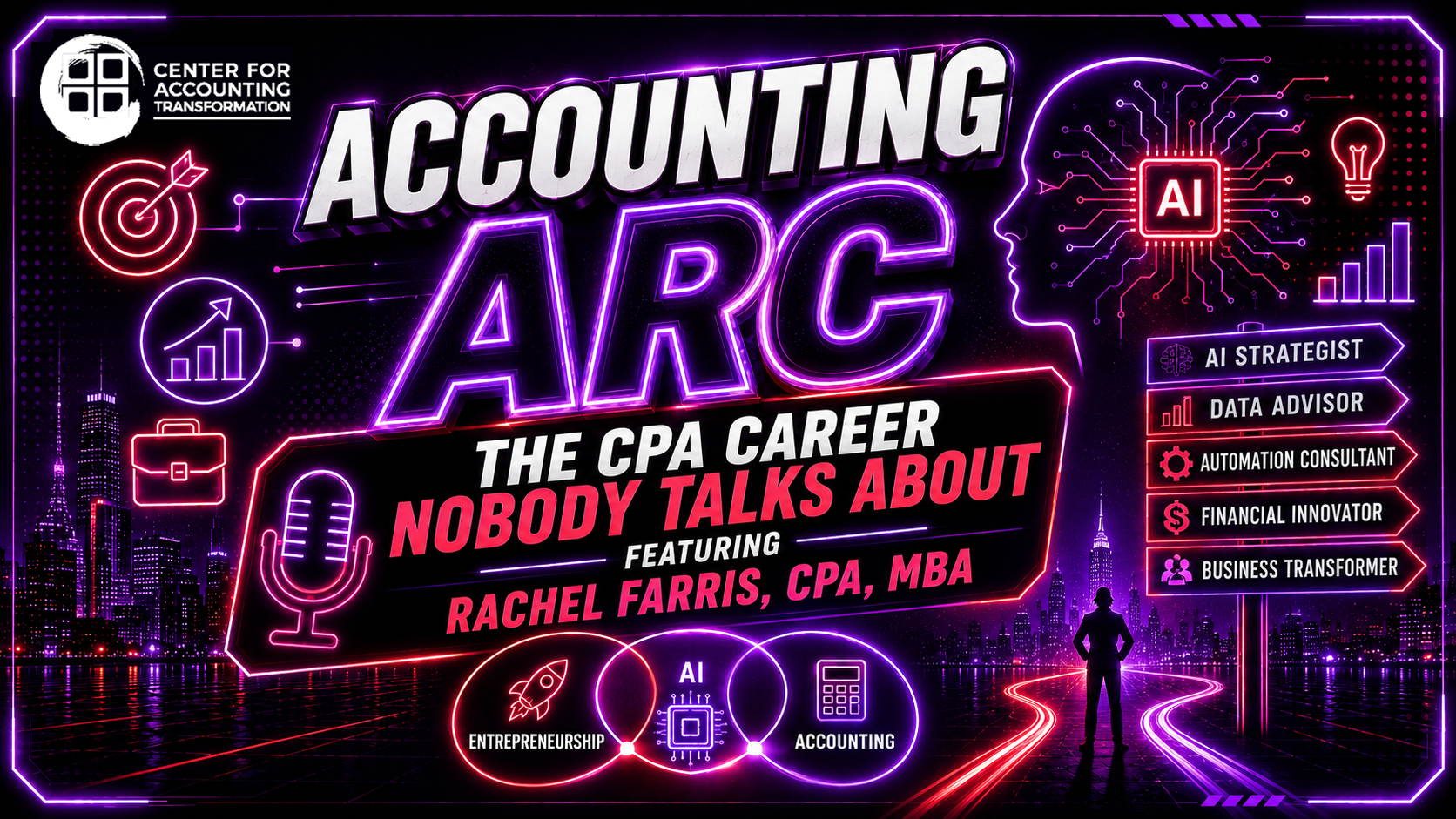
Rachel Farris shows how the next generation of accountants is blending entrepreneurship, AI, and advisory into careers that barely existed a few years ago.
For decades, the accounting profession has followed a familiar script: earn a CPA license, join a firm, climb the ladder, and perhaps become a partner. Rachel Farris, CPA, MBA, is proving there is another way.
After building a highly specialized tax advisory practice serving U.S. citizens relocating to Puerto Rico, Farris launches Tax Stack AI, a company that helps accounting firms implement artificial intelligence securely and strategically. She has since sold her CPA practice to focus on AI consulting and education, demonstrating that today’s accounting professionals can create careers far beyond traditional public accounting.
In this episode of Accounting ARC, Donny Shimamoto, CPA.CITP, CGMA, founder and managing director of IntrapriseTechKnowlogies LLC and founder and inspiration architect for the Center for Accounting Transformation, sits down with Farris to explore entrepreneurship, AI, networking, and the expanding possibilities available to CPAs willing to embrace change.
Their conversation becomes less about one accountant’s journey and more about the profession’s future.
A career built through specialization
Farris doesn’t begin by trying to serve everyone. Instead, she identifies an underserved niche: helping high-net-worth Americans relocate to Puerto Rico under the territory’s tax incentive programs. Rather than simply preparing tax returns, her firm guides clients through complex financial, legal, and operational decisions that require collaboration with attorneys, wealth managers, and family offices. The result is a practice centered on advisory relationships instead of transactional compliance.
“We don’t service your everyday Joe down the street,” Farris says. “It involves the whole process of advisory, even from moving advisory.”
That specialization transforms both the client experience and the economics of the practice. Instead of billing by the hour, Farris builds long-term engagements around planning, implementation, and ongoing guidance. Shimamoto notes that this reflects a broader shift occurring throughout the profession, where accountants increasingly become coordinators of complex business decisions rather than processors of financial information.
Accounting becomes the center of the conversation
One theme surfaces repeatedly throughout the discussion: accountants rarely work in isolation anymore. Whether helping a client relocate internationally or implementing AI across an organization, success depends on bringing together multiple professionals with different expertise. Farris regularly collaborates with attorneys, wealth managers, investment advisers, and business leaders to build comprehensive strategies for clients.
For Shimamoto, whose own consulting work focuses on organizational transformation, that collaborative role illustrates one of accounting’s least understood strengths. Students often imagine accountants sitting quietly behind computer screens. The reality, both agree, looks very different.
“It’s more of a people role than I think other people realize,” Farris says.
AI doesn’t replace accountants—it amplifies them
While much of the profession debates whether artificial intelligence will eliminate accounting jobs, Farris offers a different perspective. Her company grows out of tools she initially develops inside her own tax practice. As other firms begin asking about those custom workflows, she recognizes an opportunity to build a separate business around AI implementation and advisory services. Yet despite running an AI company, she rejects the growing narrative that every accountant must become an AI expert.
“I don’t think everyone needs to be AI native,” she says.
Instead, she argues that firms should identify leaders who deeply understand AI while equipping everyone else to use approved, secure tools effectively. Shimamoto, whose career includes technology risk consulting, strongly agrees. Rather than expecting every CPA to become a software engineer, both believe firms should focus on helping professionals understand when and how AI creates value—and when human judgment remains essential.
That perspective challenges one of the profession’s loudest conversations today. Technology may become more sophisticated, but accounting remains fundamentally about solving human problems.
Relationships still matter
Technology occupies much of the conversation, but networking receives equal attention. Farris pushes back against the stereotype that younger professionals avoid building relationships. Instead, she believes many early-career accountants simply misunderstand what networking actually means. Networking is not delivering an elevator pitch. It is approaching people with curiosity. From waiting after presentations to introduce herself to industry leaders to sending LinkedIn messages and asking thoughtful questions, Farris credits much of her career growth to consistently putting herself in rooms that initially feel intimidating.
“The worst someone can say, for the most part, is no,” she says.
Shimamoto sees that willingness to engage as one reason Farris stands out among emerging leaders in the profession.
Experience teaches what classrooms cannot
When students ask how to prepare for careers like hers, Farris doesn’t start with coursework. She starts with experience. She encourages students to work during high school or college, complete internships, volunteer and shadow professionals—even if only a few hours each week. Those experiences, she argues, develop communication, confidence, and professional judgment long before someone enters full-time employment.
“I don’t look back on school and say that’s what served me most in my career,” she says. “It’s the work experience.”
Shimamoto reflects that his own early work experiences shaped his understanding of accounting in much the same way, helping classroom concepts become practical business skills.
Confidence becomes a professional skill
Perhaps the most personal portion of the conversation centers on imposter syndrome. Despite earning national recognition as one of CPA Practice Advisor’s 40 Under 40 professionals, Farris admits her first reaction is often wondering whether she deserves to be in the room. Rather than eliminating those doubts, she learns to move forward anyway. She encourages young professionals to build confidence internally—not through arrogance, but by believing they belong at the table, even as they remain open to learning.
Shimamoto relates immediately, sharing that if he could give advice to his younger self, it would be to speak up sooner and take more risks earlier in his career. Together, they suggest that confidence is less about having every answer than believing mistakes do not define professional worth.
A different vision for the next generation
Farris’ career illustrates how quickly accounting continues to evolve. She combines tax strategy, AI consulting, technology implementation, entrepreneurship, public speaking, and education into a professional path that would have been difficult to imagine even a decade ago. Yet throughout the conversation, neither she nor Shimamoto argues that accounting itself has fundamentally changed.
Instead, they suggest the CPA credential has become more valuable precisely because it opens doors into so many different kinds of careers. The next generation of accountants may prepare tax returns. They may build AI workflows. They may launch technology companies. Or they may do all three.
For students and professionals wondering what comes next, Farris offers a simple reminder: accounting is still the language of business. The difference is that today’s accountants have more ways than ever to speak it.
 Listen to the full episode
Don’t miss an episode. Be sure to SUBSCRIBE below: