0

May 20, 2026
Why Relationships Still Drive Career Success
By: Center For Accounting Transformation / podcast
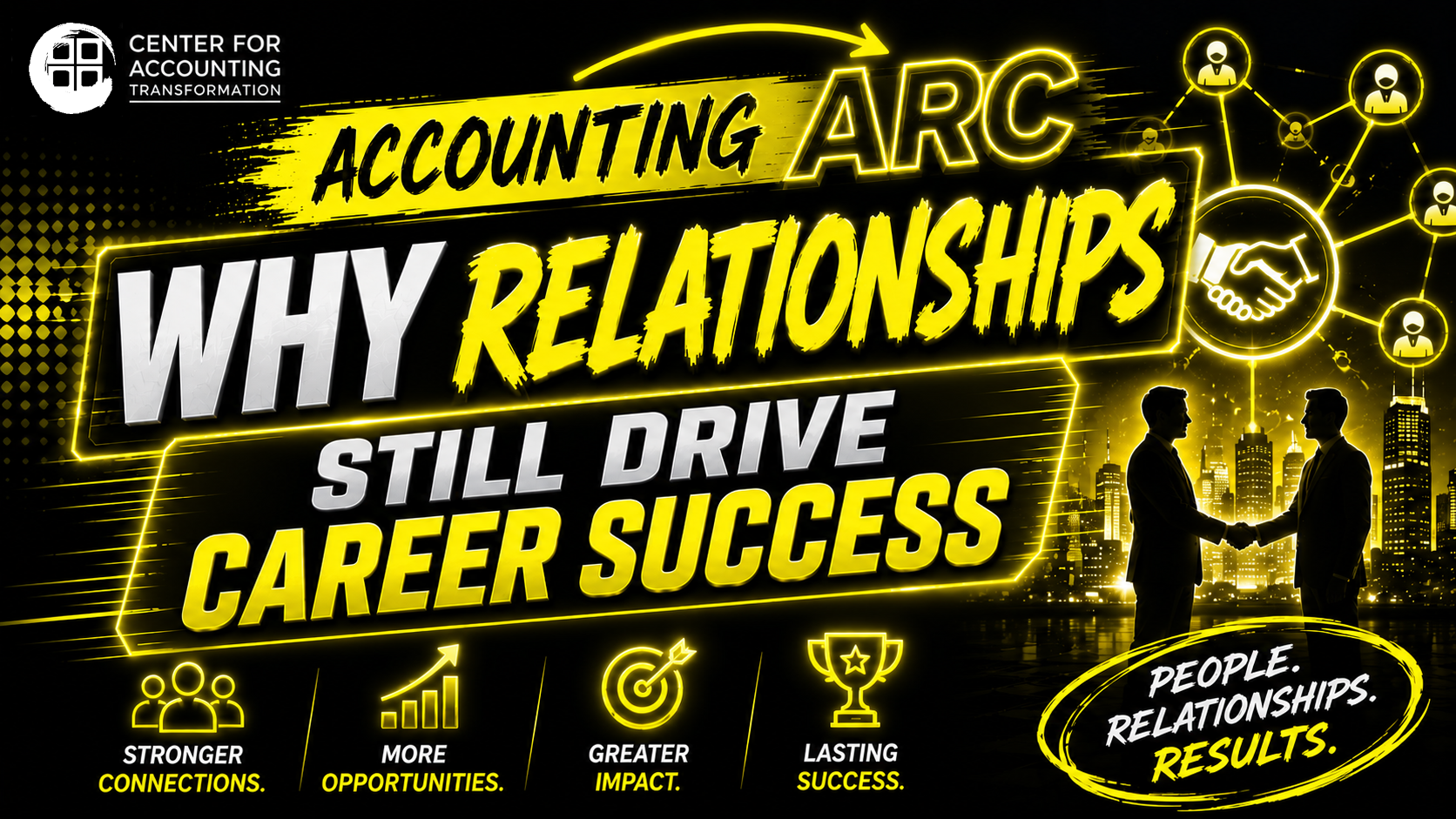
Connections create career opportunities, resilience, and leadership growth.
In the accounting profession, technical excellence is expected. However, according to the latest episode of Accounting ARC, relationships — not just work product — often determine who grows, who leads, and who thrives.
In a candid and deeply personal conversation, Liz Mason, CPA, and Byron Patrick, CPA.CITP, explore how relationship-building shapes careers, creates opportunity, and provides stability in an unpredictable profession.
Technical Skills Open Doors — Relationships Sustain Careers
Mason, CEO of High Rock Accounting, opens the discussion by reflecting on how little emphasis the profession places on teaching interpersonal skills. Patrick, senior product manager for Karbon and co-founder and part-time educator for TB Academy, agrees. “You don’t learn it in college,” he says. “There’s no course on building relationships.” That gap, they argue, becomes especially obvious early in a professional’s career.
Mason describes entering public accounting at just 19 years old with a mindset focused entirely on productivity and technical performance. Building personal relationships with colleagues seemed secondary to delivering accurate work and meeting expectations. Looking back, she now sees that approach differently.
“You are there to make friends and be good at your job,” Mason says. “People are much more patient with you if they like you.”
A Difficult Conversation That Changed Everything
The episode centers on one defining moment early in Mason’s career. After challenging a manager’s technically incorrect review comments too bluntly, she learned that even accurate feedback can damage working relationships if delivered without empathy.
Instead of letting the situation fester, Mason invited the manager to lunch. What followed changed her perspective on workplace dynamics entirely.
During the conversation, the two discussed family, hobbies, and life outside the office. Mason discovered the manager had once been an elite-level skateboarder before settling into family life. That personal connection transformed their working relationship.
“That was the first time in my career when I realized I needed to show my humanity at work to actually be received as a human,” Mason says.
Patrick says those types of moments are often career-defining, even if professionals do not recognize it at the time.
Curiosity Creates Opportunity
Throughout his own career, Patrick says curiosity about people became one of his greatest professional strengths. As a young accountant, he built close relationships with clients and colleagues alike — relationships that often extended far beyond the workplace. That investment, he says, consistently “paid dividends,” even though networking itself was never the goal.
The conversation also explores how workplace culture increasingly affects retention, especially among younger professionals. Patrick shares that his daughter, an engineer early in her career, recently left a firm because the environment lacked meaningful human connection. “There was no vested interest in who she was as a human,” he says.
That experience reinforces a broader point the hosts make throughout the episode: professionals want more than transactional workplaces. They want community.
Leadership Requires More Than Technical Excellence
The discussion touches on leadership as well. Mason acknowledges a difficult reality many professionals encounter inside firms and organizations: technically brilliant employees do not always advance if they struggle to connect with others.
“People get promoted when they’re liked,” Mason says.
While uncomfortable, she argues that leadership requires trust, communication, and emotional intelligence alongside technical skill. The hosts also discuss how professional communities often create opportunities that cannot be predicted in advance. Their own collaboration on Accounting ARC grew from years of overlapping relationships developed through conferences, professional associations, and industry conversations.
Community Creates Career Resilience
Those connections, they say, provide more than career advancement. They create resilience.
“To me, having a good community and building good relationships means you never have to worry about falling off a cliff and not landing on your feet,” Mason says.
Patrick agrees, noting that strong professional relationships have removed much of the fear and uncertainty that often accompany career transitions.
Why Saying “Yes” Matters
The episode closes with practical advice for younger professionals: say yes more often, invest time in associations and committees, ask how you can help others, and stay genuinely curious about the people around you.
“Care about your people,” Mason says. “Build community.”
For a profession often associated with technical precision and productivity metrics, the conversation serves as a reminder that long-term success is still deeply human.
 Listen to the full episode
Don’t miss an episode. Be sure to SUBSCRIBE below: