0

August 17, 2026
Accounting Internships Need an Upgrade
By: Center For Accounting Transformation / podcast
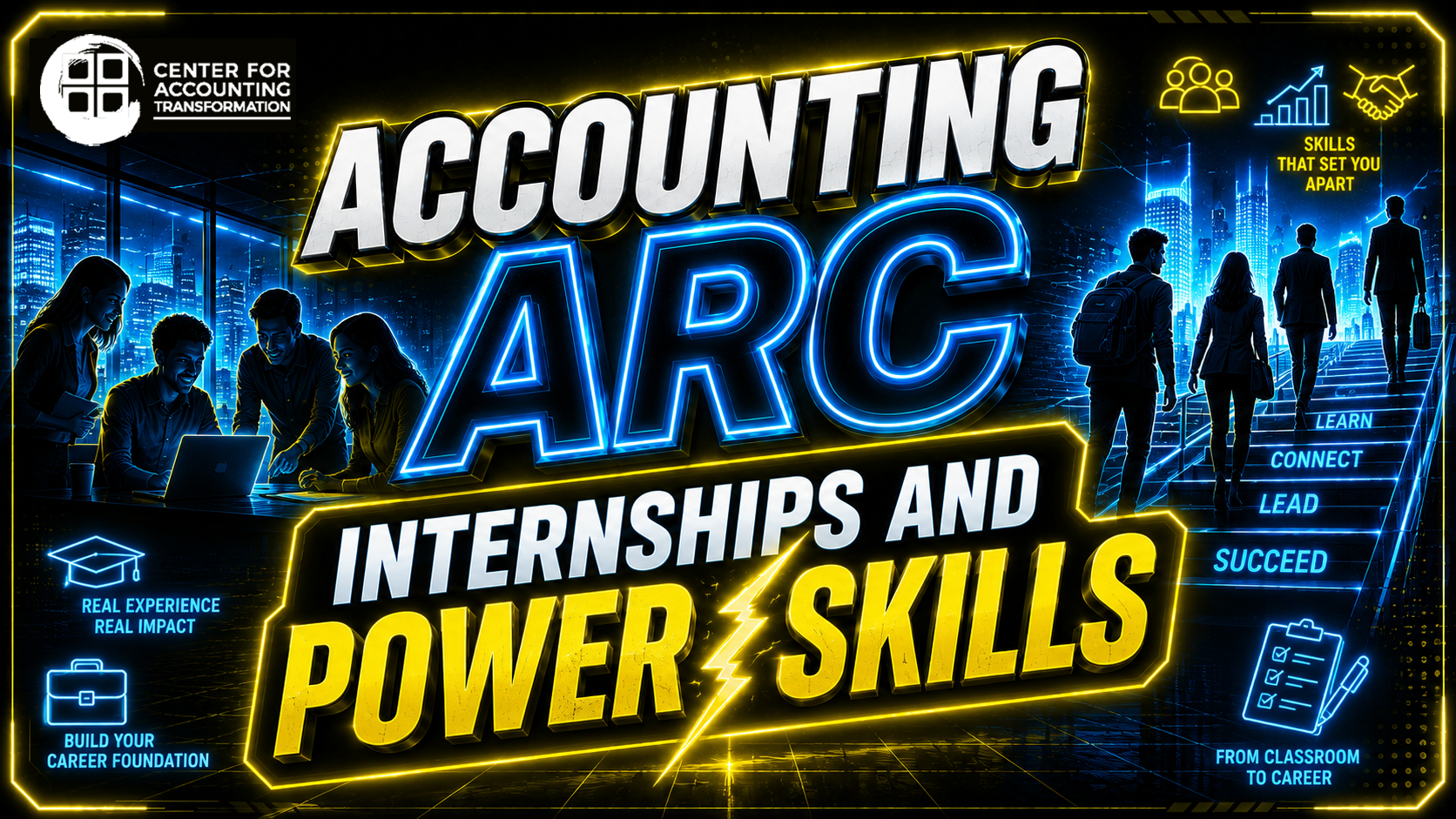
As AI changes entry-level accounting work, firms need internships that develop critical thinking, communication and other power skills.
The accounting internship is due for an upgrade.
For decades, internships often give aspiring accountants their first real taste of the profession by dropping them into the work: Learn the process, complete the assignment, survive busy season, and figure out the unwritten rules along the way. But as artificial intelligence takes over more of the entry-level work traditionally assigned to new accountants, Donny Shimamoto, CPA.CITP, CGMA, and Liz Mason, CPA, argue the profession needs to reconsider what an internship is actually supposed to teach.
In this episode of the Accounting ARC podcast, Shimamoto, founder and managing director of IntrapriseTechKnowlogies LLC and founder and inspiration architect for the Center for Accounting Transformation, and Mason, CEO of High Rock Accounting, explore why tomorrow’s accountants need more than technical proficiency.
They need what Shimamoto calls “power skills.”
When the entry-level job changes
The conversation begins with KPMG’s efforts to rethink internship development around skills such as critical thinking — a shift Shimamoto sees as a response to AI’s growing role in accounting.
“Your critical thinking skills become even more important,” Shimamoto says.
Mason sees the development as part of a larger evolution the entire profession needs to consider. Interns and new graduates are no longer entering accounting simply as technicians performing the repetitive work generations before them used to learn the profession.
“We’re not entering data entry, right, every day,” Mason says. “We’re interacting with AI, and we’re leading critical thinking, thoughts, and we’re organizing. It is a very different state of the profession, and so our internship programs need to evolve.”
That evolution creates a challenge. If technology handles more routine work, how do young accountants develop the judgment, communication, and leadership capabilities they once gradually acquired while doing it?
The power-skills gap
Mason points to workforce research identifying gaps between what employers expect and what new graduates bring into the workplace, particularly in areas such as communication, teamwork, professionalism, critical thinking, career and self-development, and leadership. She deliberately moves away from calling them “soft skills.”
Shimamoto offers another term: power skills.
“I feel like they’re really the things that drive a more powerful and a more effective leader at all levels,” he says.
The distinction matters because these skills are becoming more valuable, not less, in an AI-enabled workplace. Students may arrive with impressive technology capabilities — sometimes exceeding the proficiency employers expect — but knowing how to use AI does not automatically mean knowing how to question its output, communicate with a manager, collaborate with a team, or navigate professional expectations. Those capabilities often develop through experience.
And that makes the internship increasingly important.
Stop expecting colleges to teach everything
It is easy for employers to blame higher education when new hires arrive without every skill they want. Shimamoto and Mason push back on that expectation. Accounting programs already have an enormous amount of technical material to cover.
“Have you seen what they have to cover?” Shimamoto asks employers. “Do you remember what we cover in that class?”
Mason agrees that experiential and problem-based learning can help students develop critical thinking, but universities face practical limitations. Professors have a finite number of classroom hours to teach complex accounting concepts. If programs replace technical instruction with more communication, leadership and professional-development training, students risk graduating without sufficient accounting fundamentals.
“You can’t do everything,” Mason says.
That means employers, professional associations and other organizations share responsibility for closing the gap. Internships can become the bridge.
Learning the rules no one explains
Mason’s own early-career experience illustrates how seemingly small workplace expectations can create significant problems for young professionals. During her internship and early career, she recalls being given instructions for a project by a manager who moved rapidly through the assignment. Mason processes information best by listening first and taking notes afterward. Her manager interpreted the lack of note-taking differently. When Mason missed two details from the conversation, the issue appeared on her performance review as a failure to take notes and pay attention.
“I was devastated by that performance review because I thought I nailed it,” Mason says.
The problem isn’t simply whether a young accountant carries a notebook into a meeting. It is the disconnect between an employer’s unspoken expectations and an employee who doesn’t yet know those expectations exist. Today’s technology adds another wrinkle. An intern might solve the note-taking problem with an AI meeting assistant — but does that intern understand when consent is required before using it? These are workplace lessons that rarely appear in an accounting textbook.
“There’s all these gaps of things that you come out of school, and you’re like, I can use these fancy tools, I can do this, I can do that,” Mason says. “But at the same time, it’s the same learning process that we all had to go through.” Formalizing that learning, she says, can make a significant difference.
Internships should teach self-awareness, too
Shimamoto sees another lesson in Mason’s story: Young professionals need to understand and communicate how they work best. Rather than assuming everyone learns, communicates, or processes information the same way, an internship can help students recognize their own working styles and explain them professionally. That can be especially important for neurodivergent employees and others whose learning or communication styles do not match traditional workplace expectations. Mason says that early in her career, she didn’t know what she needed to communicate about how she processes information or what accommodations might be available. Those lessons become part of the larger power-skills conversation.
“You don’t learn how to communicate your needs,” Mason says. “You don’t learn how to actually show up from a communication perspective, or a leadership perspective.”
A different model for internships
Shimamoto says the Center for Accounting Transformation is working on an internship model designed to combine practical accounting experience with professional development. The concept brings together schools, nonprofits, firms and the Center, giving students progressively broader exposure to accounting work. Students can begin with financial accounting and bookkeeping for nonprofits, move into managerial accounting and internal audit, and gain exposure to tax work with support from accounting professionals.
The goal isn’t simply to give interns tasks. It is to help them understand the different ways accountants work — and where they might fit.
Shimamoto argues that internships should expose students to tax, audit, finance, and other potential career paths. Mason adds that students also need exposure to different workplace cultures. Public accounting isn’t corporate accounting. Finance has another culture. Client accounting and advisory services offer yet another experience. Students need opportunities to discover not only what they can do, but what they actually want to do.
The pipeline belongs to employers, too
Ultimately, Shimamoto and Mason reject the idea that preparing the next generation is solely the responsibility of colleges and universities. Large firms may have the resources to build sophisticated internship and training programs. Smaller firms may need support from professional associations, schools, and profession-wide initiatives. But employers cannot sit out the process and then complain that graduates aren’t ready.
“Recognize your own role and responsibility,” Shimamoto says. “Really, it’s the pipeline for you.”
That pipeline doesn’t end when an intern accepts a full-time offer. The same development process determines whether entry-level employees become seniors, managers and, eventually, leaders.
AI only raises the stakes. If technology accelerates young accountants past the repetitive work that once filled their early careers, firms need to become much more intentional about replacing those experiences with something better. That means internships designed not merely to fill a staffing need, but to teach young accountants how to think, communicate, lead, adapt, and understand where they belong in the profession.
“Get involved, think about this, work hard to make sure young people are set up for success,” Mason says, “so our profession has a future.”
 Listen to the full episode
Don’t miss an episode. Be sure to SUBSCRIBE below: