0

September 3, 2026
AI Isn’t Erasing Tax Careers. It’s Rewriting Them
By: Center For Accounting Transformation / podcast
As automation absorbs more preparation work, firms must build new pathways that develop reviewers, judgment and client-facing skills.
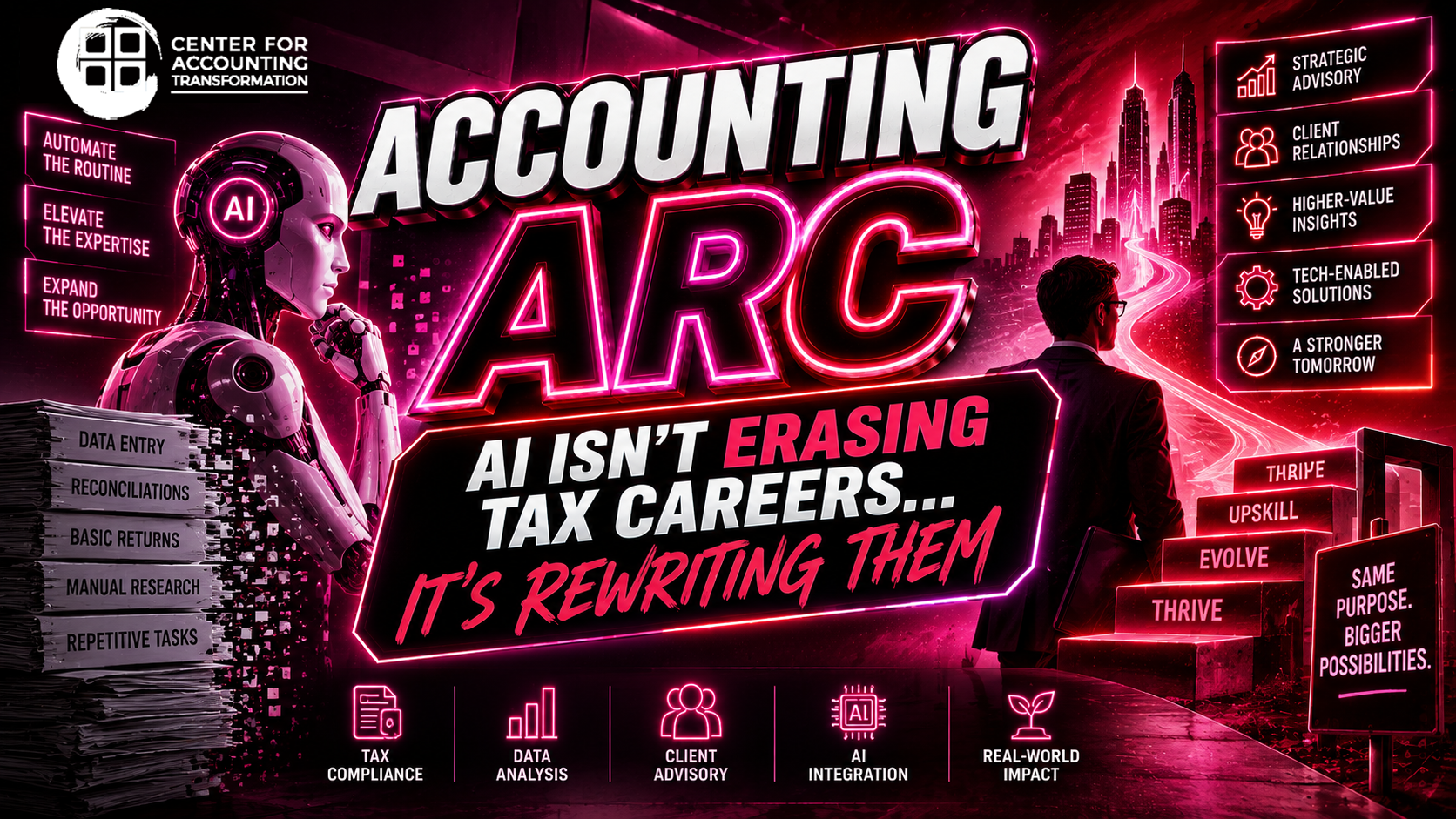
Artificial intelligence may not eliminate the entry-level tax professional. But it is dismantling the job that many firms still use to train one.
That’s the conversation driving a new episode of the Accounting ARC podcast featuring Donny Shimamoto, CPA.CITP, CGMA, founder and managing director of IntrapriseTechKnowlogies LLC and founder and inspiration architect for the Center for Accounting Transformation; and Liz Mason, CPA, CEO of High Rock Accounting.
The conversation begins with a small tax firm that hires six interns each year and teaches them to prepare returns much as earlier generations learned: working from paper documents, identifying relevant numbers, mapping those figures to tax forms, and entering the data into tax software.
The firm owner sees the process as an apprenticeship that helps students bridge the gap between an individual tax course and real-world preparation. Shimamoto sees value in teaching interns how information moves from source documents to a completed return. Mason agrees with the objective but challenges the method.
“From a holistic learning exploration, sure, yes, that is a way to learn,” Mason says. “From a where-we-are-today perspective, I think that’s a giant disservice to these interns.”
Teach the work that remains
Mason argues that forcing interns to build muscle memory around a paper process creates an unnecessary transition when their actual careers will unfold on screens and inside automated systems. Firms can still teach the flow of tax information, she says, but they should do it in the environment where employees will work. That distinction matters because the profession is not moving directly from human preparation to no human involvement. It is shifting from manual entry toward verification, exception handling, review, and advice.
“We need to train people on what a good tax file looks like, what good support looks like, and how you detail-review and tie it out before that ever ends up on a signer’s desk.”
Shimamoto suggests that firms using scanning and extraction tools can ask interns to verify what the technology captures. That preserves an important learning exercise: identifying relevant information, understanding where it belongs, and questioning whether the output makes sense. The larger obstacle, however, is not preparation capacity. It is the shortage of reviewers.
As automation and offshoring absorb more basic preparation, Shimamoto says the traditional firm pyramid temporarily becomes a diamond, with fewer people at the bottom and more demand in the middle. Over time, he expects the structure to flatten again as automated preparation becomes standard and the primary onshore role shifts toward review.
That raises a harder question for firms: If employees no longer spend years learning through repetitive preparation, how do they become qualified reviewers?
One review role becomes two
Mason’s answer begins by separating two jobs that many small firms combine. The detailed reviewer traces the flow of information, checks support, tests assumptions, and considers tax positions, elections, credits, and planning opportunities. The signer takes a higher-level view, confirms that the critical questions have been addressed, and accepts responsibility for the return.
“Detailed review takes a lot of time,” Mason says. “Signer review takes more of the, ‘Hey, did you think about this, this, this, this, this? Yes? OK, let’s go.’”
In many small firms, a partner performs both functions. That makes review appear to require decades of experience and creates a bottleneck no amount of faster preparation can solve. Mason argues that firms can move capable preparers into detailed review much faster when expectations are documented. Checklists, standardized workpapers, and clearly defined methodologies move knowledge out of a veteran reviewer’s head and into a process others can learn.
Shimamoto connects the distinction to structures already familiar elsewhere in accounting: A controller performs a detailed financial review before a CFO signs the statements, while an audit manager leads the engagement before a partner signs the opinion.
Byron Patrick, CPA.CITP, who joins the episode during the discussion, recalls working at a firm where one highly skilled reviewer handled much of the technical review. The arrangement is efficient, he says, but it also exposes the firm to risk because no one else develops the same capability.
Different strengths belong in different roles
The discussion also challenges the assumption that a successful tax professional must excel at every stage of the process. Preparation, detailed review, and signing require overlapping knowledge but different aptitudes. A strong preparer creates a complete, traceable file. A strong reviewer works backward, spots inconsistencies, and asks whether the team considered every relevant issue. A signer applies professional judgment, weighs risk, and communicates with the client.
Mason learned that distinction early in her career. As an intern, she often reached the correct answer but failed to document how she got there. A partner responded by assigning her to review other interns’ returns. Seeing answers she believed were wrong — but supported by a visible line of reasoning — taught her why another professional must be able to follow the file.
“We need to train people on what a good tax file looks like, what good support looks like, and how you detail-review and tie it out before that ever ends up on a signer’s desk,” Mason says.
That lesson also opens tax careers to people whose strengths may be overlooked in a linear prepare-review-sign model. Someone who struggles with preparation may excel at review. Someone with strong judgment and communication skills may be especially valuable in client conversations after technology has computed the available alternatives.
AI can become the training ground
The next generation of tax technology moves beyond extracting information and populating forms. Mason describes AI systems that identify inconsistencies, test ties to prior-year returns and workpapers, surface planning possibilities, and allow users to question each review point in real time. That immediate feedback can shorten a learning cycle that once required a preparer to wait days for a manager, then return to a file after the context had faded. Patrick, a senior product manager for Karbon and founder and part-time educator for TB Academy, calls the tools a potential training ground for professionals who actively investigate the feedback rather than accept it at face value. The caveat is crucial. AI does not automatically create better learners.
Shimamoto warns that firms must design an intentional learning loop. Before consulting the system, a professional should form an expectation about what the return should show. After receiving the output, that person should test whether it makes sense, determine what the system missed, and ask why a recommendation appears.
Mason says software design also influences behavior. A tool that instantly produces a client-ready message can encourage button-pushing. A tool that asks whether the accountant has considered a research and development tax credit — and explains the factors behind the suggestion — invites analysis. The distinction is not merely educational. It reaches the profession’s ethical obligations.
Shimamoto says accountants must remain “human in the lead,” applying professional judgment and skepticism rather than simply accepting a system’s conclusions. Mason adds that technology developers have a responsibility to create systems that advance learning instead of rewarding disengagement.
Firms have a choice. They can preserve outdated work because it once produced capable professionals, or they can redesign development around the work people will actually perform. AI may reduce the need for manual tax preparation. It also makes the profession’s distinctly human responsibilities — judgment, skepticism, documentation, communication, and accountability — more visible and more valuable.
 Listen to the full episode
Don’t miss an episode. Be sure to SUBSCRIBE below: