0

January 5, 2026
The Accounting Reset
By: Center For Accounting Transformation / podcast
Inside the forces transforming firm operations, competition, and long-term growth.
At the start of the year, the hosts of Accounting ARC did something uncommon in professional commentary: they went back and graded their own predictions.
In the program’s New Year episode, Donny Shimamoto, Liz Mason, and Byron Patrick revisited what they expected the profession to experience last year, what actually happened, and what those signals now suggest about the year ahead. What emerged was not a tidy forecast, but a clearer map of how accounting is being reshaped — and what firm leaders should be paying attention to.
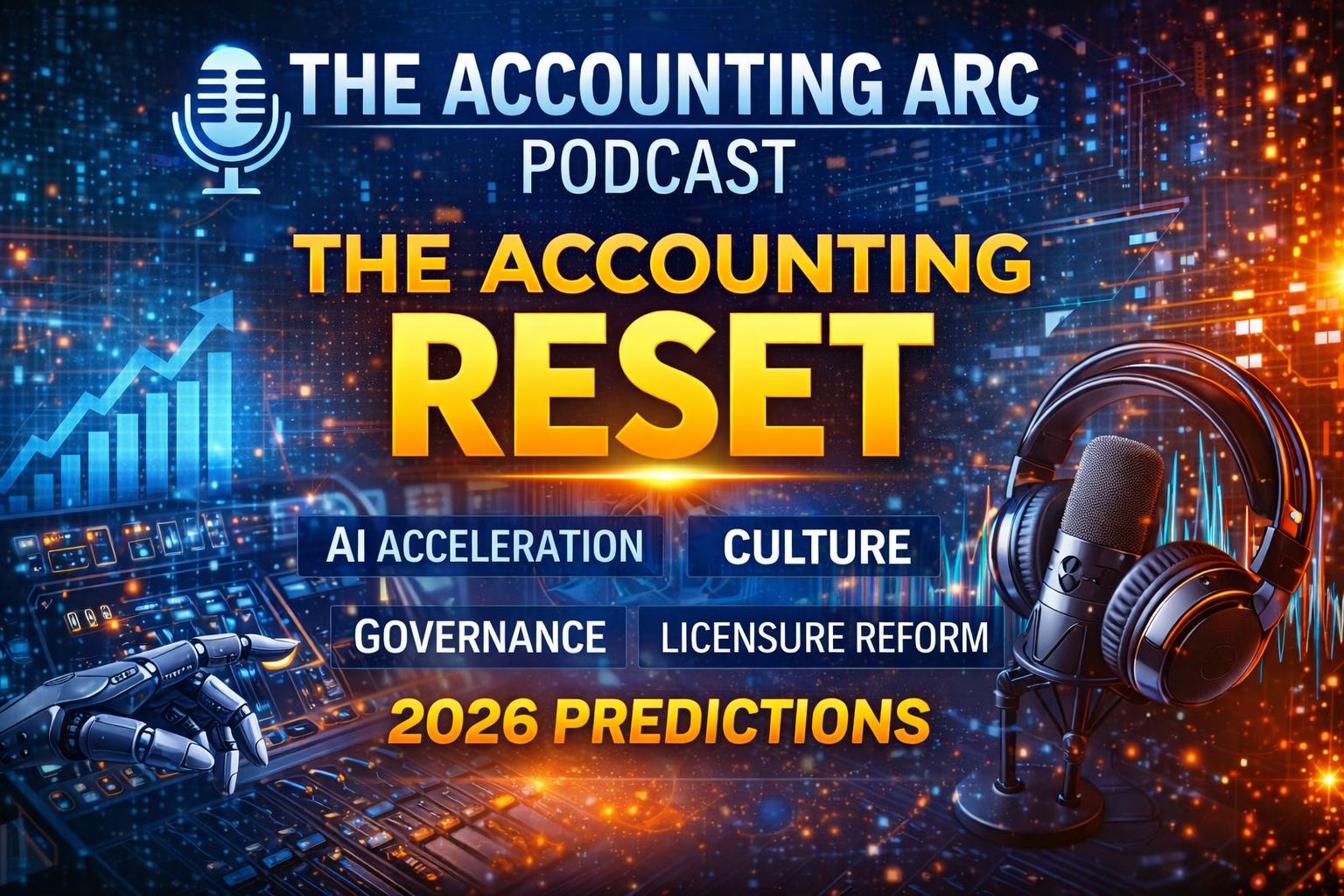
Three forces dominated the conversation: licensure reform, AI acceleration, and the growing importance of culture and governance.
Licensure Reform Is Moving Faster Than Expected
Byron Patrick opened the discussion with a prediction he believes “landed pretty well”: the rapid evolution of CPA licensure pathways. He noted that more than twenty states now have alternative models either enacted or in development, many pairing 120 credit hours with additional experience requirements.
The hosts framed licensure reform as more than regulatory change. It represents a structural shift in how firms attract, develop, and retain talent. New entry pathways will bring new expectations around training models, career progression, and long-term workforce strategy.
AI Is Rewiring the Work — Not Replacing It
Liz Mason’s reflection on artificial intelligence was more nuanced. While she predicted the profession would begin moving from fear toward adoption, she acknowledged that emotional resistance remains. Many practitioners recognize AI’s potential while still feeling unsettled by its implications.
Donny Shimamoto agreed that adoption is accelerating, describing 2025 as the year generative AI began visibly compressing timelines — from software development to business processes — in ways that extend well beyond accounting. That compression, he argued, is reshaping how work is structured and how firms compete.
The hosts’ shared conclusion: AI is not replacing accountants. It is fundamentally rewiring the work they do.
“AI Becomes the New Cloud”
Where the panel aligned most strongly was on expectations. Mason predicted that in the near future, “AI becomes the new cloud.” It will no longer serve as a differentiator; it will become a baseline assumption.
Shimamoto expanded on this, suggesting that “AI-powered” and “AI-assisted” will soon function as minimum requirements for competitive tools. Systems that fail to evolve risk being perceived as legacy, regardless of other capabilities.
Agentic AI and the Design of the Modern Firm
Agentic AI emerged as one of the most debated topics. Patrick expects 2026 to mark the point when AI agents begin performing meaningful operational tasks within firms. Mason sees a bifurcation forming: one lane led by consulting and implementation specialists, and another composed of firms built “AI-native” from inception.
Shimamoto’s skepticism is grounded in experience. He cautioned that orchestration and interoperability remain major obstacles — the same constraints that limited earlier technology integration efforts. His advice to firms is direct: stop layering new tools onto outdated assumptions. Start instead with a blank page and design the firm you would build today.
Governance, Ethics, and Market Correction
The conversation extended beyond operations into broader market dynamics. The hosts expect increasing pressure around governance, bias, data responsibility, and regulatory oversight. Mason emphasized the risk of reinforcing social bias through poorly governed systems. Shimamoto highlighted the need for stronger vendor due diligence and attention to environmental and community impacts tied to large-scale data infrastructure.
Together, they anticipate that market enthusiasm around AI will eventually encounter a correction — one that forces more realistic valuations, clearer accountability, and stronger governance frameworks.
Why Smaller Firms May Hold the Advantage
One of the episode’s most practical insights is that smaller firms may have the clearest path forward. With fewer legacy systems and constraints, they are often able to adopt new technologies more quickly and redesign workflows more effectively.
If AI continues to compress timelines and expand capacity, speed becomes a competitive weapon. Firms that move with intention may outperform peers in ways previous technology cycles never allowed.
A New Operating Reality
The hosts offered no simple conclusion about whether 2026 will be “good” or “bad” for the profession. Instead, they described a new operating reality:
- Licensure will continue shifting.
- AI will become table stakes.
- Governance will become unavoidable.
- Culture will increasingly shape competitiveness.
Firms that respond thoughtfully — rather than reactively — will be best positioned to shape the next phase of the profession instead of merely surviving it.
Don’t miss an episode. Be sure to SUBSCRIBE below: