0

August 24, 2026
From “Synergy” to “Skibidi”: Who Defines Professionalism?
By: Center For Accounting Transformation / podcast
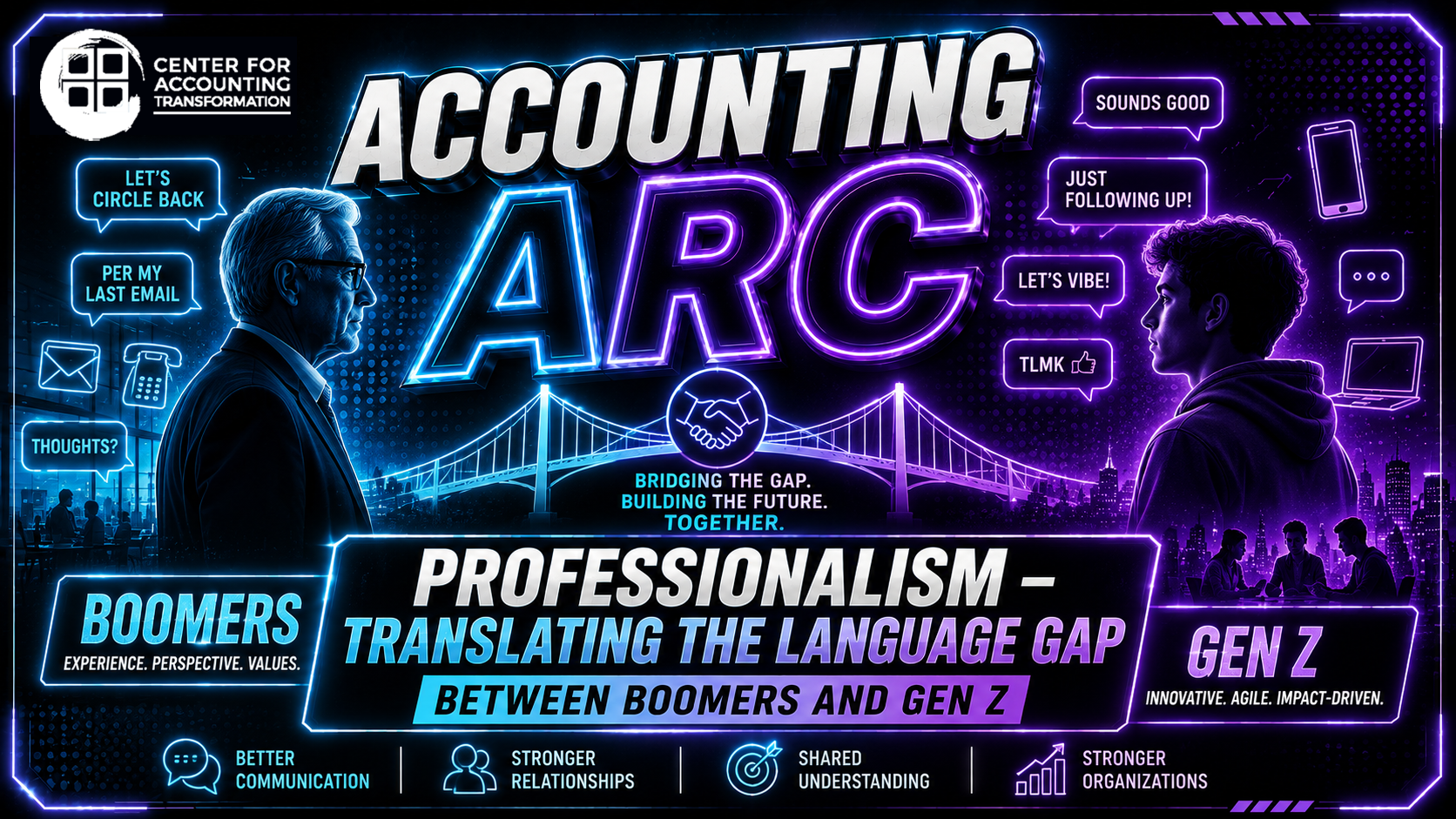
Workplace language continues to evolve, but effective professionals still need to know their audience, understand the setting, and communicate in ways that others can receive.
Every generation enters the workplace speaking a slightly different language.
For Generation Z, that language may include phrases such as “delulu,” “mid” and “fire.” For earlier generations, the dated vocabulary might sound different, but the underlying challenge remains familiar: How do people bring their authentic voices to work while still communicating professionally?
In this episode of the Accounting ARC podcast, Donny Shimamoto, CPA.CITP, CGMA; Byron Patrick, CPA.CITP; and Liz Mason, CPA, examine the supposed language barrier separating Generation Z and baby boomers — and question whether it is really as new or insurmountable as some portray it.
Their conclusion is less about memorizing the latest slang and more about developing an essential power skill: adaptability.
“Bottom line, know your audience and adapt to the room you’re in,” Patrick says.
Every generation brings its own vocabulary
The conversation begins with Shimamoto reacting to an article claiming that boomers and members of Generation Z speak such different workplace languages that they need an app to translate between them. Shimamoto is skeptical. Every generation develops colloquialisms, regional expressions and cultural shorthand, he says. Professionals have traditionally learned that entering the business world requires understanding how people communicate in that particular environment.
American workplaces include people from different regions, cultures, and linguistic backgrounds. Elevating the language of one generation while dismissing dialects associated with minority communities raises deeper questions about which voices businesses consider legitimate.
Patrick, senior product manager for Karbon and founder and part-time educator for TB Academy, sees both sides of the debate. Members of Generation X grew up expecting a business world filled with IBM-style suits, ties and formality, he says. Many later rejected those conventions, but that does not eliminate the need for discretion. Employees can speak however they choose among friends, Patrick explains, but workplace communication carries a different objective.
“Your goal is to be understood when you are communicating,” he says. “If you are using language that the audience does not understand, you’re not going to be a good communicator.”
Mason, CEO of High Rock Accounting, agrees that businesses generally operate through an understood professional vocabulary. Millennials also entered the workforce with their own slang, she notes, and quickly learned that some expressions did not belong in client emails or formal meetings. That does not mean business language should remain frozen in time. It does mean changes must support, rather than obstruct, understanding.
Professional language is not personal language
People already switch between different forms of language throughout their daily lives. Mason says she would not use phrases such as “circle back” or discuss “synergy” during an ordinary personal conversation. Those expressions belong to a business dialect, just as families, communities, and regions may have dialects of their own.
Shimamoto, who is founder and managing director of IntrapriseTechKnowlogies LLC and founder and inspiration architect for the Center for Accounting Transformation, points to Hawaii Pidgin as one example. It can build powerful connections among local audiences, but speakers must consider whether everyone in the room understands it.
Mason says that same consideration should extend beyond generational slang. American workplaces include people from different regions, cultures, and linguistic backgrounds. Elevating the language of one generation while dismissing dialects associated with minority communities raises deeper questions about which voices businesses consider legitimate.
“We have an agreed-upon language,” Mason says. “We use our agreed-upon language, and that can evolve.”
The central issue is not whether a word is new, old, formal, or informal. The question is whether it helps the speaker communicate effectively in that setting.
Context shapes what looks and sounds professional
The hosts also challenge the idea that communication is limited to vocabulary. Clothing, body language, personal presentation and workplace culture all affect how an audience receives a message.
Patrick rarely wears a suit and has received criticism for appearing underdressed in some settings. His knowledge often helps him overcome that initial resistance, Shimamoto says, but his clothing can create an additional barrier before he begins speaking. Mason notes that Patrick’s technology-oriented professional identity gives him greater freedom to reject conventional dress expectations. A professional in a traditional accounting firm may face a different reaction.
Those expectations are not applied equally, either. Mason says seemingly minor choices, such as wearing her hair down or putting it in a messy bun, can affect whether others view her as an experienced professional or “just some kid.” Race, gender, height, clothing, and other physical characteristics can also influence how a message is perceived.
Patrick acknowledges that his identity gives him more leeway to challenge certain norms.
“It definitely creates additional friction and challenges,” he says. “I do think it depends on who you are, in a lot of respects, how much tolerance you have to get away with those different things.”
Effective communication, then, requires more than choosing understandable words. Professionals must recognize the assumptions operating in the room and decide whether challenging those assumptions will advance or interfere with their message.
Adaptability does not require abandoning authenticity
Shimamoto offers an example from a recent presentation in Hawaii. He begins by establishing his professional credentials and speaks while wearing aloha attire, a customary form of business dress in Hawaii. Later, he shifts into Pidgin for selected examples because he knows it will resonate more strongly with the local operations-focused audience. He does not change his expertise or identity. He changes how he delivers the message.
Mason identifies that as adaptability: communicating in a way the audience can receive rather than defaulting to the style most comfortable for the speaker. That does not mean older professionals should force Gen Z slang into every college presentation. Misusing unfamiliar language can sound artificial and undermine credibility.
Instead, professionals should understand the audience, the message, and the expectations of the setting. A speaker recruiting students into accounting may communicate differently from a professor teaching a technical concept or an accountant presenting findings to an audit committee.
The strongest communicators make those adjustments deliberately.
AI adds another language barrier
The ability to adapt language also matters when professionals communicate with artificial intelligence. Large language models are trained on particular bodies of language and predict outputs based on the words and patterns users provide. Mason says team members around the world may need to adapt their natural communication styles when writing prompts to produce the results they want. That adds a technological dimension to an already complicated power skill. Employees must learn to communicate across generations, cultures, and professional environments — and now with machines whose responses can change significantly based on how a request is phrased. For accounting firms, this makes communication training more important, not less.
Firms must define the language of their culture
The responsibility does not rest entirely with younger employees. Shimamoto says firms and finance departments must recognize that workplace norms will continue evolving as new generations enter the profession. Leaders have the authority — and responsibility — to establish clear standards for communication and professionalism.
Those choices also affect recruitment and retention. A rigid culture may alienate professionals who want room to express themselves. A culture with no shared expectations may leave employees uncertain about how to communicate with colleagues and clients.
The answer is not an app that translates every generational phrase. It is a workplace willing to define its expectations, explain the reasons behind them, and remain open to thoughtful change.
“Recognize that we are all going to adjust to some of this new generation coming in,” Shimamoto says. “It’s your choice to really set what is the standard.”
Ultimately, the language of business does not belong permanently to boomers, Generation X, millennials, or Generation Z. It belongs to the people trying to accomplish something together. The best communicators understand that being authentic matters — but being understood matters, too.
 Listen to the full episode
Don’t miss an episode. Be sure to SUBSCRIBE below: