0

March 31, 2026
When “What If” Becomes Reality
By: Center For Accounting Transformation / article
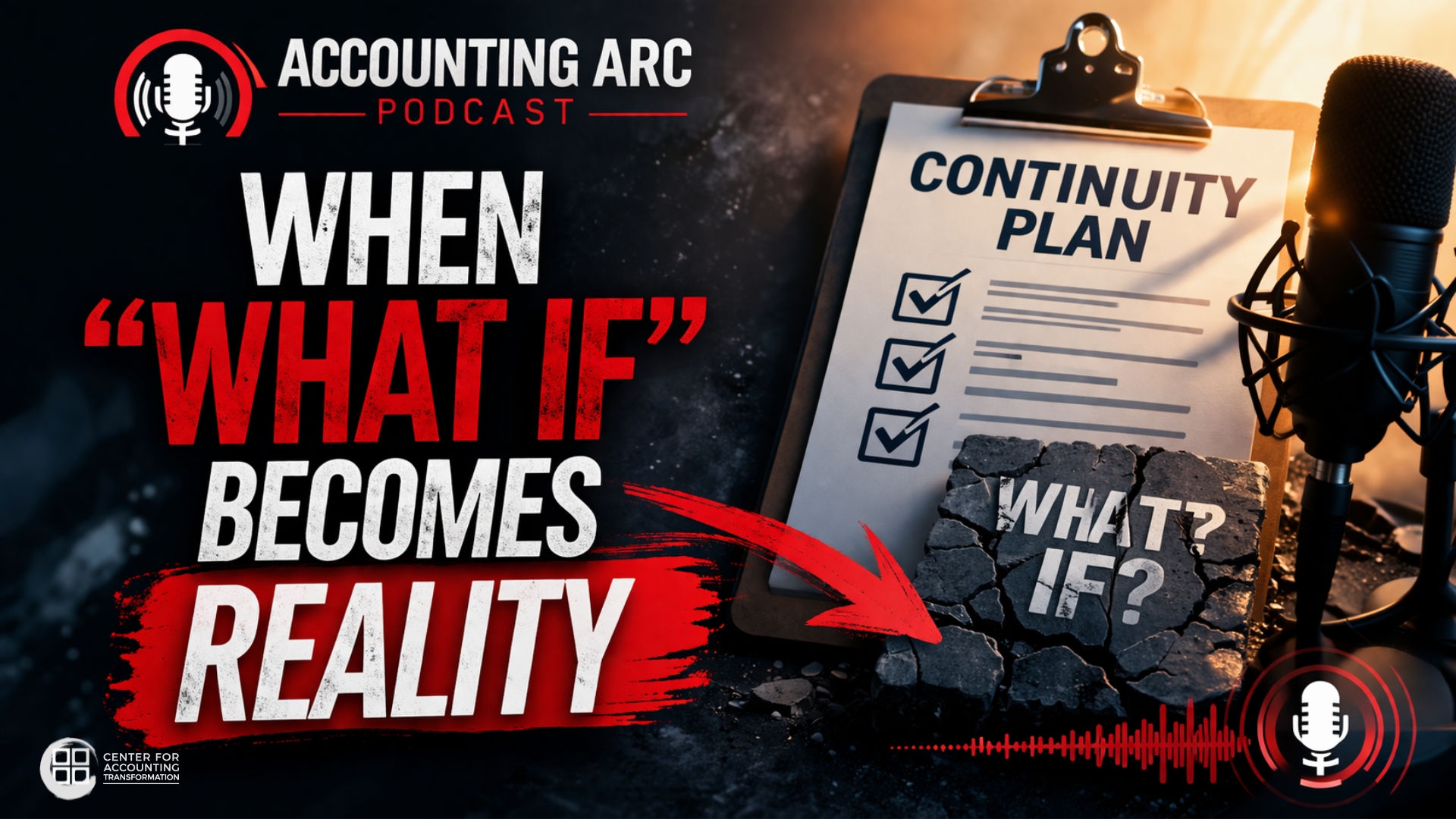
A near-tragedy sparks a critical conversation on business continuity, risk, and responsibility in accounting firms.
Business continuity planning often lives in the realm of “someday.” Until it doesn’t.
In the latest episode of Accounting ARC, hosts Donny Shimamoto, CPA.CITP, CGMA; Byron Patrick, CPA.CITP; and Liz Mason, CPA, tackle a topic many professionals avoid: what happens when the unexpected actually happens. The conversation opens not with theory, but with a moment that makes the stakes unmistakably real.
Mason, CEO of High Rock Accounting, recounts a recent skiing accident in which she fell roughly 200 yards and collided with a tree at high speed. She survived with a broken leg—but the incident forced a sobering question: What would have happened to her firm if she hadn’t?
“I almost died,” she says plainly, noting that her team quickly realized the importance of the systems already in place to protect the business.
That moment becomes the anchor for a broader discussion: continuity isn’t theoretical. It’s operational risk management—one that too many firms ignore.
Planning for the Uncomfortable
For many business owners, continuity planning is both overwhelming and deeply uncomfortable. It requires confronting scenarios most would rather avoid: death, disability, or sudden disruption.
Patrick acknowledges the hesitation. “It’s something you don’t want to think about,” he says, noting that between day-to-day demands and emotional resistance, it’s easy to delay planning indefinitely. But avoidance carries consequences.
Without a plan, businesses can fall into probate, become entangled in legal disputes, or be sold quickly—often for far less than their true value. Clients lose service continuity. Employees lose stability. Families inherit complexity instead of clarity. Shimamoto frames the issue in familiar terms for accountants: it’s not unlike estate planning.
“You have to help clients think through the ‘what if,’” he says. “Sympathetically, but logically.”
The Building Blocks of Continuity
Mason outlines several practical mechanisms firms can implement—starting with ownership and leadership continuity. Her firm maintains life insurance policies tied to a buy-sell agreement, ensuring that if one partner dies, the other can immediately acquire ownership and keep the business running without disruption.
For sole practitioners, the approach looks different but is no less critical. Practice continuation agreements—formal arrangements with another firm to step in during death or disability—provide a pathway to maintain client service and preserve value. But continuity extends far beyond ownership.
The hosts emphasize three core pillars:
- People continuity: Cross-training and shared knowledge reduce dependency on any single individual. Mason describes a “two-person rule,” ensuring at least one additional team member understands every key process.
- Decision-making continuity: Clear authority structures prevent operational paralysis. Without defined leadership, even routine decisions can stall a firm.
- Systems and access continuity: Firms must ensure that critical systems—software, data, permissions—remain accessible even if a key administrator is unavailable.
“If I were incapacitated,” Mason notes, “who could access and manage our systems?”
The Overlooked Risk: Vendors
Beyond internal operations, the episode highlights a growing external threat: vendor dependency. Accounting firms increasingly rely on specialized software platforms. But what happens if those platforms fail?
The hosts point to real-world examples, including ransomware incidents and vendor shutdowns that left firms without access to systems, data, or even email—sometimes at critical deadlines. Mason shares her own experience with a project management vendor that abruptly pivoted away from accounting firms, effectively cutting off access to processes and workflows. The result: weeks of rebuilding systems and a temporary disruption in client service. That experience fundamentally changed how she evaluates vendors.
Now, continuity questions are non-negotiable:
- Can data be exported easily?
- Are backups available?
- What happens if the vendor shuts down?
“If you’re not satisfied with the answer,” she says, “that’s not a good continuity plan.”
Balancing Risk and Cost
One of the episode’s most practical insights is the need to balance preparation with efficiency. Over-engineering backup systems can create unnecessary cost. Under-preparing can be catastrophic. The solution, Shimamoto explains, lies in basic risk assessment:
- What is the likelihood of an event?
- What is the severity of its impact?
From there, firms can determine how much time, money, and effort to invest in mitigation. This framework also applies to cybersecurity, where firms must evaluate the cost of downtime against the cost of prevention.
A Small-Firm Problem—Magnified
A key theme throughout the discussion is that continuity planning is not just for large organizations. In fact, it may matter more for small firms. Smaller organizations often rely heavily on a single owner or a small leadership team. Without redundancy, any disruption can halt operations entirely.
“Your clients and your employees become dependent on your ability to continue,” Shimamoto says.
That dependency raises the stakes—not just for the business owner, but for everyone connected to the firm.
Turning risk into advisory opportunity
The conversation ultimately reframes continuity planning as more than an internal exercise. It’s also an advisory opportunity.
Firms can guide clients through the same questions:
- What happens if the owner is suddenly unavailable?
- Who takes over operations?
- How is value preserved?
These conversations, while difficult, position accountants as proactive advisors—not just compliance providers.
The episode closes on a simple but urgent message: don’t wait for a crisis to test your plan. Continuity planning doesn’t require perfection. It requires intention. Think through the scenarios. Ask the uncomfortable questions. Build redundancy where it matters most.
Because when “what if” becomes reality, the firms that are prepared aren’t scrambling. They’re still operating.
 Listen to the full episode
Don’t miss an episode. Be sure to SUBSCRIBE below: