0

April 14, 2026
From MVP to Meltdown: Why Accounting Tech Struggles to Scale
By: Center For Accounting Transformation / podcast
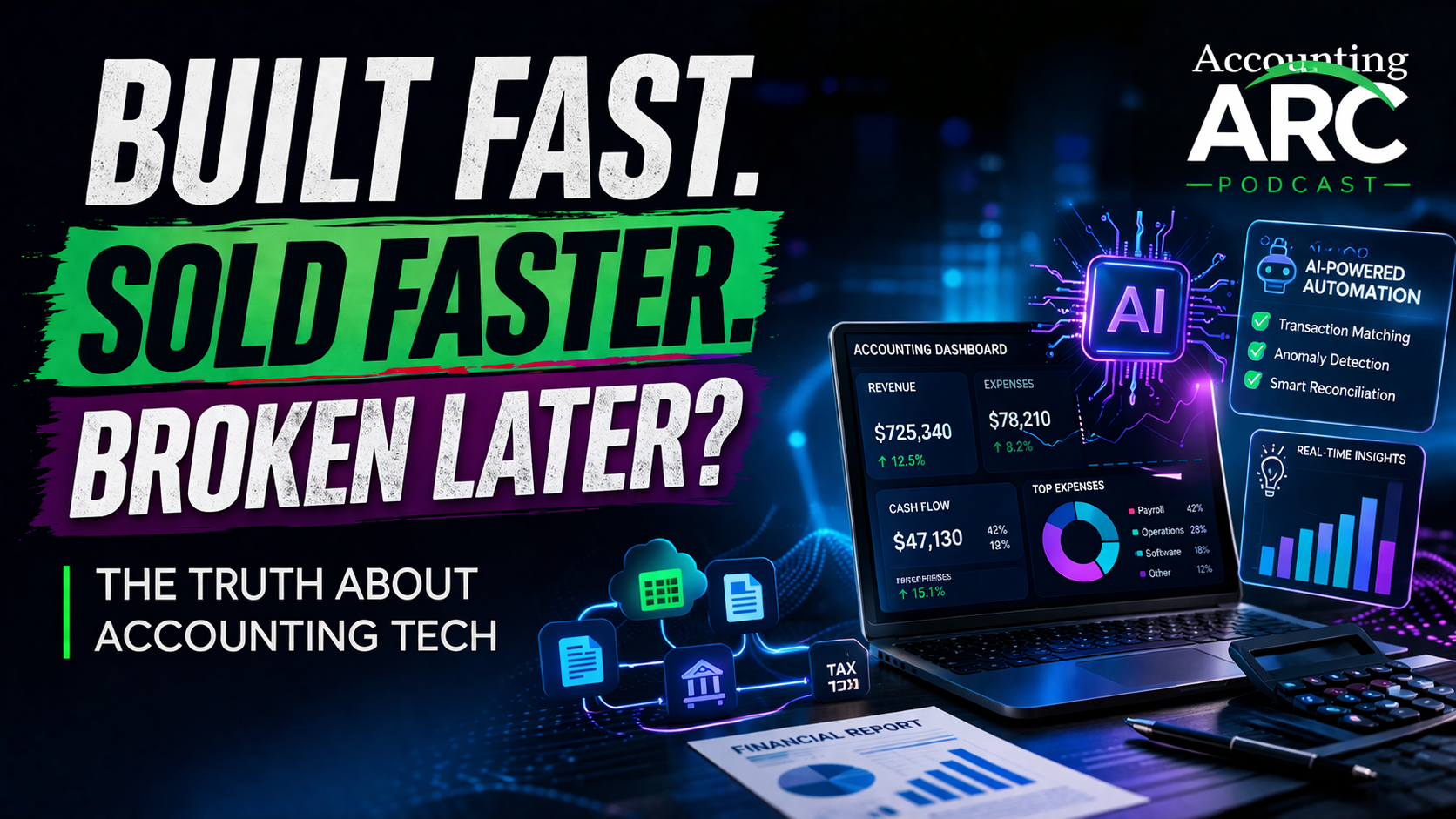
ARC hosts examine how venture capital, sales pressure, and scalability challenges shape which solutions survive.
The accounting technology market looks crowded from the outside. New tools launch every month. Conference expo halls overflow with promise. And artificial intelligence is accelerating everything.
But beneath that surface, the economics of building accounting technology tell a more complicated story—one shaped as much by venture capital and sales pressure as by innovation itself.
In the latest episode of Accounting ARC, Byron Patrick, CPA.CITP, and Liz Mason, CPA, step back to examine how the industry got here—and where it is likely headed next.
The “Big Three” still dominate
Despite the influx of startups, the foundation of accounting technology remains concentrated among a handful of legacy providers.
“The success of the solutions is rarely based on having a good product. It’s usually based on having a good sales and marketing arm.”
Patrick, a senior product manager for Karbon and co-founder and educator for TB Academy, describes three dominant players: Wolters Kluwer, Thomson Reuters, and Intuit.
These companies built their reputations on tax, audit, research, and general ledger systems—often designed decades ago and later adapted for the cloud.
“They’ve been standing players in the industry for a very long time,” says Mason, CEO of High Rock Accounting, noting their reach across enterprise firms, mid-market practices, and local offices.
But longevity comes with trade-offs. While these firms continue to innovate—often through acquisitions or internal development—the pace and structure of that innovation differ sharply from newer entrants.
Venture capital fuels—and distorts—innovation
Over the past five years, venture capital has reshaped the accounting tech landscape. According to Patrick, the result has been a surge of new solutions entering—and often exiting—the market at high speed.
“There’s been a lot of technology that has not been built to be sustainable,” he says. “It’s been built for a moment in time to make a buck.”
Mason outlines the typical startup lifecycle: an idea, a founding team, early funding from friends, family, or angel investors, and eventually a venture capital round. From there, companies enter what she calls the “fundraising cycle.” Each round of funding raises expectations for growth—and valuation. That creates pressure to prioritize expansion over stability.
“You’re constantly having to feed the monster,” Patrick says, describing the need to deliver returns to investors while still building a functional product.
The MVP trap
One of the biggest structural challenges in accounting tech is how products are built. Startups are often encouraged to launch quickly with a minimum viable product (MVP)—a stripped-down version designed to attract early users and validate demand. But that speed comes at a cost.
“It is easy to build a program to solve a problem,” Mason says. “It is not easy to build a program that you build on top of and scale.”
As a result, many companies eventually face a costly and complex process: rebuilding their core systems. Even established platforms go through this cycle. Replatforming—rewriting foundational code to support growth—is not a sign of failure, but a necessary stage in development.
Product quality vs. market success
In an ideal world, the best technology would win. Realistically, success often hinges on something else entirely.
“The success of the solutions is rarely based on having a good product,” Patrick says. “It’s usually based on having a good sales and marketing arm.”
That dynamic creates a disconnect between innovation and adoption—where technically strong solutions struggle, while well-marketed products gain traction. Mason acknowledges the tension, noting her own tendency to support smaller, more innovative vendors—even when they don’t survive.
Why accounting attracts so much innovation
Despite these challenges, accounting remains one of the most attractive sectors for technology development. The reason is simple: scale and structure. Every business needs accounting. The workflows are predictable. And the data is highly structured—ideal for automation.
“We have solvable problems,” Mason says.
That combination creates a large total addressable market—and a steady influx of new entrants trying to capture it.
AI and the next wave
If venture capital drove the last wave of innovation, artificial intelligence is poised to accelerate the next. Patrick describes the current moment as a new “gold rush,” with AI layered on top of an already crowded landscape. The result will likely be an even greater explosion of tools—along with new approaches to building them.
One emerging trend: firms developing their own internal solutions.
“I would seriously consider… building as much of the software in-house as I could,” Patrick says.
This shift toward “personal software” or firm-specific tools could reshape the vendor ecosystem—especially for smaller practices that have historically been underserved.
A call for deeper participation
Ultimately, both hosts see the future of accounting technology as a collaborative effort—not something built solely by vendors. Mason argues that accountants themselves need to play a more active role in shaping solutions.
“It requires the people in our industry to participate in what that looks like from a technology perspective,” she says. That means moving beyond advisory boards and beta testing—and toward meaningful ownership and influence.
A widening gap—and a bigger opportunity
As innovation accelerates, one tension remains unresolved: the gap between the pace of technology change and the pace of adoption.
“The rate of tech change is just increasing,” Mason says, “and the rate of tech adoption is not.”
Closing that gap may define the next era of accounting.
For firms willing to engage—whether by adopting new tools, building their own, or helping shape the ecosystem—the opportunity is significant. For those that don’t, the risk is just as real.
 Listen to the full episode
Don’t miss an episode. Be sure to SUBSCRIBE below: